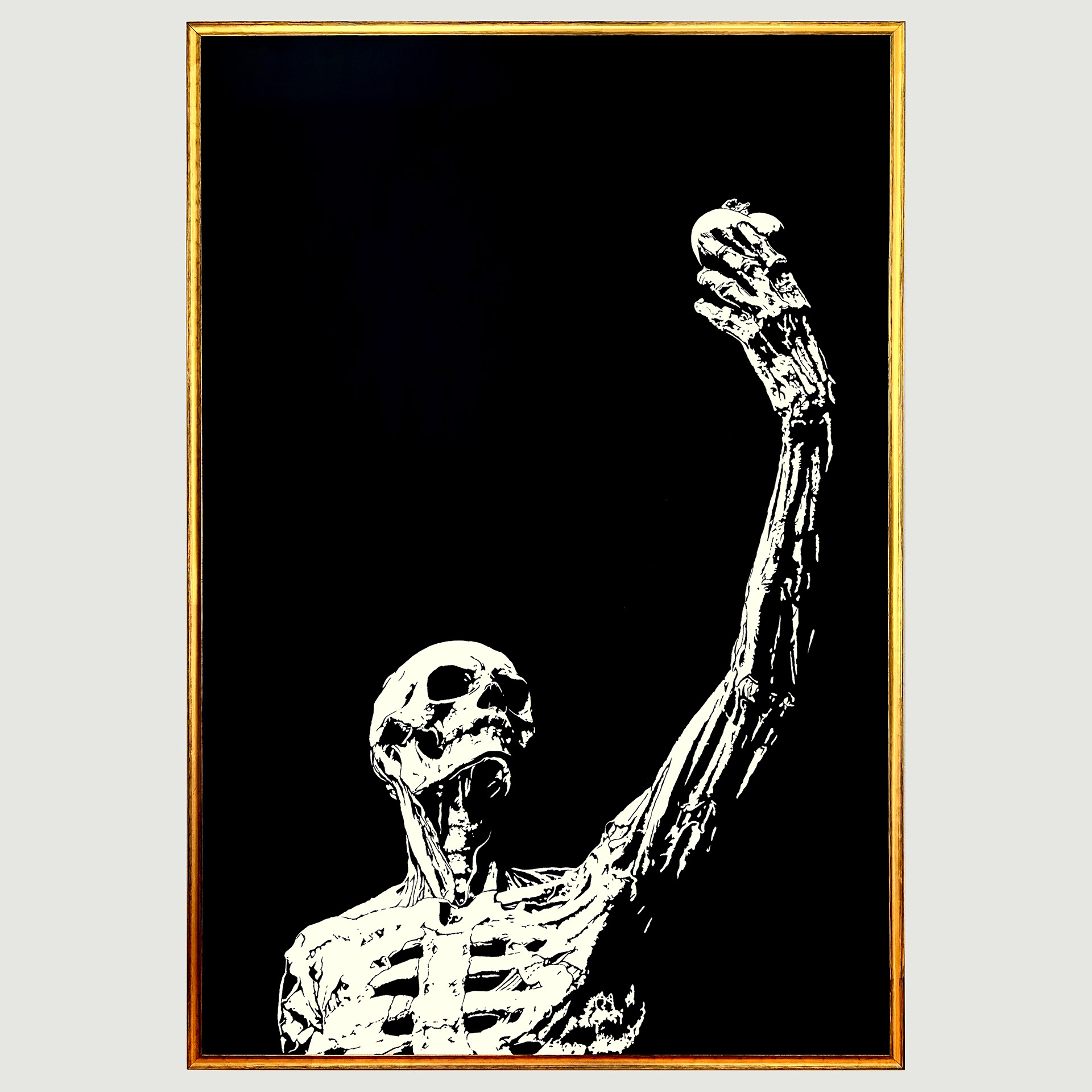
The Heart of Man
Emulsion on canvas
24" x 36"
2026
Emulsion on canvas
24" x 36"
2026
For sale via le cèr
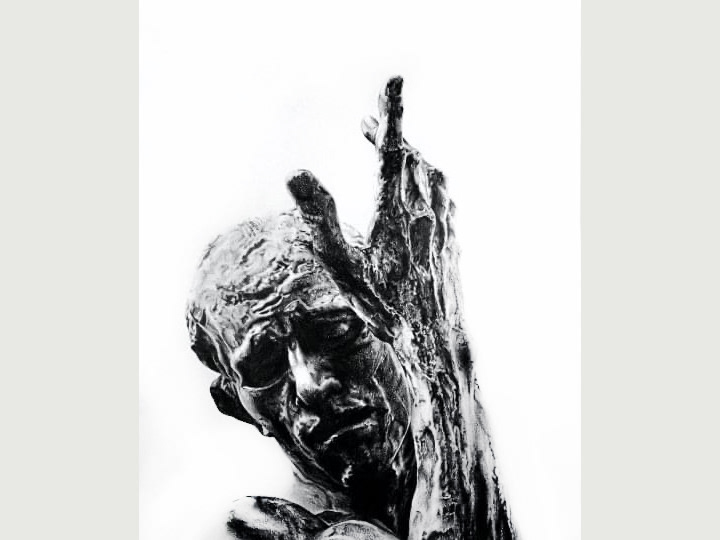
This macabre portrait of a rotting corpse, raising its own heart to behold, is Collins' second interpretation of Ligier Richier's "Le Transi de René de Chalon" (also known as "Le squelette"), a life-sized transi of the Prince of Orange from the mid sixteenth century. Collins discovered the Richier's late gothic, funerary, cadaver monument during a sojourn to Paris, France. That sculpture inspired Collins' earlier work, "All Things Must Die", a limited edition lithograph.
Despite their shared source, "The Heart of Man" and "All Things Must Die" explore different aspects of Ligier's masterpiece. In "All Things Must Die", Collins focused on the concept of mortality, which has fascinated artists like Collins since the dawn of humanity. The memento mori genre, to which that work belongs, is a representation of a latin maxim meaning, "remember (that you must) die". The genre has its roots in medieval, funerary art.
In "The Heart of Man", Collins turns his focus to the mysteries of human life and of the soul, symbolized in the heart. In this regard, "The Heart of Man" and "All Things Must Die" are foils of each other and of life and death, respectively. The skeleton appears to ponder its humanity, which Collins connects to his own artistic expression. Collins believes that, in their flesh, humans are their most basic, limited selves. Through their art, humans may transcend their profane existence and become their most enlightened and liberated.
"The Heart of Man" exhibits some of Collins' finest, most technically accomplished brushwork to date. It is also one of Collins' first works to use other than a white ground. Collins has harnessed the power of subtle colour to emphasize the skeletal structure of his subject.